

What if getting ready for debt review started with a clear paperwork checklist, rather than trying to remember every account and expense at once? If you’re asking, “what documents do I need for debt review?”, it’s understandable to worry that a missing or out-of-date document could delay your assessment.
A little organisation can make the process more manageable. Your debt counsellor uses your records to understand your income, regular expenses and credit commitments, then assess what repayment arrangement may be realistic. You don’t need to have every detail perfectly arranged before you start, but gathering the core documents can help you discuss your finances with greater confidence.
This guide explains which personal and income records to prepare, what to gather for your debts and monthly expenses, and how to organise everything before submitting it. It also covers what to do if your income is difficult to document or you’re unsure about an account, so you can build a clearer picture of your finances for a debt review assessment in South Africa.
Key Takeaways
- Wondering “what documents do I need for debt review”? Use the checklist to identify personal, income and financial records that can support an assessment.
- Gather available credit statements, account numbers, balances and scheduled instalments to show your monthly commitments.
- Sort and label your paperwork by category, then note what is missing before submitting it through the agreed channel.
- If your income varies or a document is unavailable, prepare a clear, honest summary of your financial position.
- A debt counsellor reviews your information and may ask follow-up questions to clarify your repayment capacity.
What documents do you need for debt review in South Africa?
Preparing key records can make a financial assessment clearer, but your document pack doesn’t have to be perfect before you start. If you’re asking, “what documents do I need for debt review?”, use the list below as a practical starting point. Applicants may need different records depending on their income, household and credit accounts.
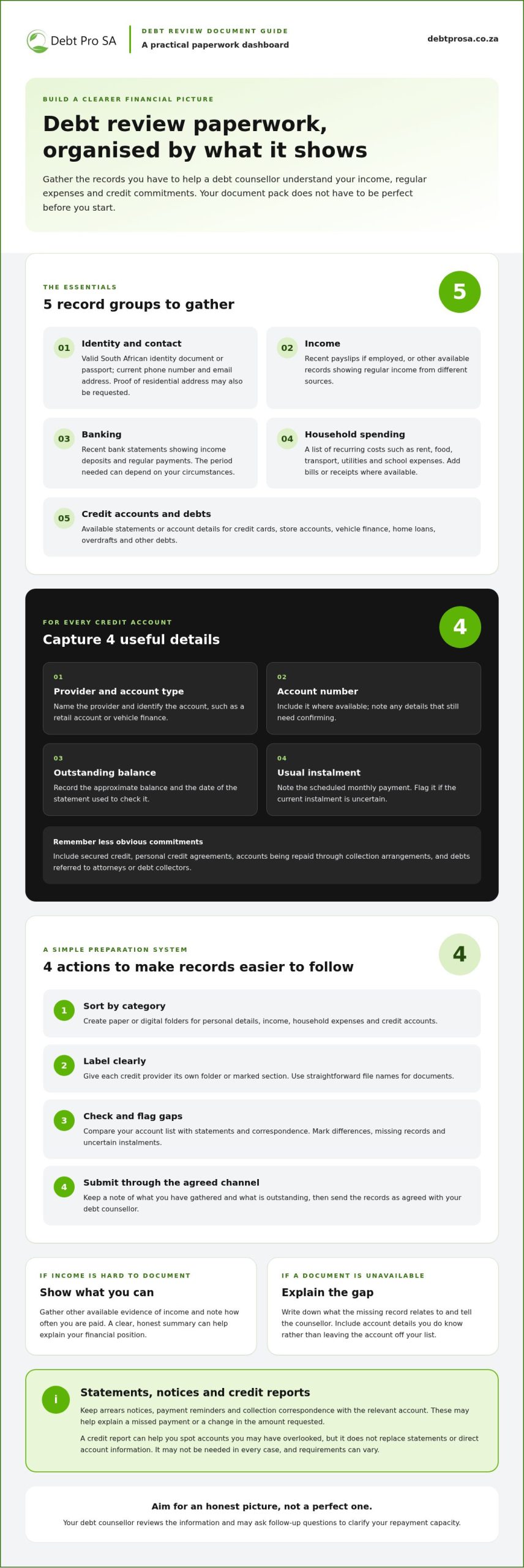
Gather what you have from these categories:
- Identity and contact details: a valid South African identity document or passport, along with your current phone number and email address.
- Income: recent payslips if you’re employed, or other records showing regular income if you earn from different sources.
- Banking: recent bank statements showing income deposits and regular payments. The period needed can depend on your circumstances.
- Household spending: a list of recurring costs such as rent, food, transport, utilities and school expenses, with bills or receipts where available.
- Credit accounts: available statements or account details for credit cards, store accounts, vehicle finance, home loans, overdrafts and other debts.
Personal identification and contact information to prepare
Your identity document and current contact details help the counsellor match your information to the correct applicant and follow up if anything needs clarification. Keep proof of your residential address handy too, as it may be requested. The records needed depend on your circumstances and the assessment.
Income, bank and household expense records
Payslips help show your earnings, while bank statements offer a broader view of money coming in and regular payments going out. If you don’t receive payslips, gather other available evidence of income and note how often you’re paid. For household expenses, a written budget is useful even if you can’t find a bill for every cost. Aim for an honest picture, not a perfect one.
Make a note of which documents you’ve gathered and which are outstanding. If a record isn’t available, write down what it relates to and explain this to the counsellor. This gives them useful context and helps identify what further information may be needed.
Which debt and credit records help a debt counsellor assess your finances?
A clear record of your credit commitments helps a debt counsellor understand how much of your income is already allocated to repayments. As you work through “what documents do I need for debt review?”, include every active credit account you can identify, not only the accounts that feel most difficult to manage. An incomplete list can make your monthly obligations harder to assess accurately.
Gather a recent statement for each account where you have one. Note the provider’s name, account number, approximate outstanding balance and scheduled instalment. Include secured credit, such as vehicle finance or a home loan, where applicable, as well as credit cards, overdrafts, personal credit agreements and retail accounts. If a detail is uncertain, mark it for follow-up rather than leaving the account off your list.
Statements and details for each credit account
Use a simple table or list to keep the information together. Record the account provider, account type, current balance and usual monthly payment in separate columns. Statements can help you check these details, but balances and instalments may change, so note the date of each statement. If you can’t find a statement, include the account details you do know and flag what still needs confirming.
Remember less obvious obligations too, including accounts being repaid through a collection arrangement or debts referred to attorneys or debt collectors. The aim is to give the counsellor a complete picture of your credit commitments, not to judge how each account arose.
Arrears, collection notices and credit bureau information
Keep recent arrears notices, payment reminders and collection correspondence with the records for the relevant account. These letters can help explain a missed payment or a change in the amount requested. A credit report can also help you spot accounts you may have overlooked, but it shouldn’t replace statements or direct account information. A report may not be needed in every case, as document requirements and statement periods can vary.
Before your assessment, compare your list with the statements and correspondence you have. Mark differences between a listed balance and a statement, or any account whose current instalment you’re unsure about. This makes it easier to discuss gaps and clarify what further information may be useful. The online debt calculator can help you consider your overall financial position, though it doesn’t replace an assessment by a debt counsellor.
How should you organise your debt review documents before submitting them?
A simple system makes it easier to find information during your assessment and can reduce avoidable follow-up questions. Once you’ve gathered your records, sort, label and check each file, then submit it through the channel agreed with your debt counsellor. This turns “what documents do I need for debt review?” into a manageable set of steps rather than one large paperwork task.
A simple checklist for sorting your paperwork
Create separate folders, on paper or digitally, for personal details, income, household expenses and credit accounts. If you have several credit providers, give each one its own folder or clearly marked section. Use straightforward file names such as bank statement August or vehicle finance statement September. Avoid putting unnecessary sensitive information, such as your full identity number, in file names.
Before submitting anything, check that each copy is complete and readable. For a scan or photograph, make sure the whole page is visible, the text isn’t blurred and no relevant pages are missing. Keep documents in date order where this helps show a sequence, such as consecutive statements or payment notices. A short contents list can also show what’s included at a glance.
- Sort: group records by category and credit provider.
- Label: use clear descriptions and document dates.
- Check: look for missing pages, cut-off details or unclear text.
- Submit: use the secure method agreed with your counsellor.
These records contain private financial and identity information. Don’t post them publicly or send them through an unapproved channel. If you’re unsure how to submit a document securely, clarify the agreed method before sharing it.
What to do if a document is missing or out of date
Don’t guess, edit a statement or present an old record as current. Make a note of what’s missing, why you don’t have it and the date of the latest version available. Label older records clearly so their age is easy to see. This gives the counsellor useful context without making the information seem more recent than it is.
If a statement is unavailable, include the account in your records and flag the gap. Your debt counsellor can explain what other information may help clarify the account. Requirements depend on your circumstances, so don’t assume that one document format or statement period applies to every applicant. An organised pack supports a clearer assessment, even if a few items still need to be followed up.
What if income, expenses or debts are hard to document?
An incomplete document pack doesn’t automatically mean you can’t begin a conversation about debt review. If you’re unsure what documents do I need for debt review, start with the information you can access and be open about what’s missing. A debt counsellor needs a realistic view of your finances, so a clear explanation is more useful than trying to make uncertain figures look exact.
Separate confirmed amounts from estimates. For example, label a figure taken from a current statement as confirmed, and mark an expense based on recent spending as an estimate. Note the period each record covers. This gives the counsellor context and makes it easier to identify what needs clarification. Documents help inform an assessment, but they don’t by themselves guarantee eligibility or a particular repayment arrangement.
Preparing records when you are self-employed or earn variable income
If you’re self-employed or your earnings change from month to month, gather the evidence you have, such as bank records showing payments received, invoices or other income records. Write a short summary explaining how often you’re paid and which amounts are regular or occasional. Label the dates covered by each record so the counsellor can distinguish an ongoing pattern from a one-off payment.
A simple table can help:
- Income received: note the amount and date, using Rands.
- Source: identify whether it came from regular work, a client payment or another source.
- Evidence: list the matching statement, invoice or other record, if available.
If a supporting document is temporarily unavailable, note that clearly. Don’t fill the gap with a guess or leave the income source unexplained.
Explaining household costs and changes in your circumstances
List your regular household costs, such as housing, food, transport, utilities and childcare. Use recent bills where possible. For costs without a bill, provide a practical estimate and mark it as such. If your circumstances have changed, explain what happened and when. A reduction in income or a new recurring expense can affect the difference between what you earn and what you can reasonably put towards repayments.
Be straightforward about arrears, irregular costs and debts you’re still trying to document. The aim isn’t to present your finances in the best possible light, but to give the counsellor an accurate starting point. To prepare a broader view of your financial position, use the online debt calculator. It can support your preparation, while a debt counsellor’s assessment considers your individual circumstances.
What happens after you give your documents to a debt counsellor?
Once you share your financial information, a debt counsellor uses it to build a fuller picture of your income, household costs, credit obligations and repayment capacity. This assessment is a starting point for discussing options that may fit your circumstances. It isn’t a promise of debt cancellation, new credit or a particular repayment outcome.
How a counsellor uses your financial information
Income records help show what money comes in and how regularly. Your expense summary gives context about essential household spending, while credit-account information shows the repayments already due each month. Together, these details help the counsellor consider whether your current commitments are manageable and what needs further discussion.
You may be asked to clarify a figure, provide a missing statement or explain a change in your income or expenses. These requests depend on the information available and your circumstances. The assessment and potential next steps must also take applicable South African requirements into account, so an outcome can’t be determined from a document checklist alone.
Preparing for a calm, useful assessment conversation
Use the information you’ve gathered to guide the conversation, not as a test you need to pass. If you’re still wondering “what documents do I need for debt review?”, write down questions about records you’re unsure about, how your information will be handled and what the assessment involves. Be ready to explain gaps or changes plainly, including when they happened and whether they’re ongoing.
A few notes can help you feel prepared:
- Mark figures that are estimates rather than confirmed amounts.
- Note which records are missing, outdated or still being obtained.
- Write down recent changes that affect your monthly budget.
- Note any clarification that could help the counsellor understand your position.
A clear, honest conversation helps the counsellor understand the realities behind the paperwork and explain relevant options without assumptions. To take a structured next step, explore Debt Pro SA’s debt review assessment or use its online debt calculator to prepare. The calculator can help you consider your financial position, but it doesn’t replace an individual assessment.
Take your next step towards a clearer financial picture
Knowing what documents do I need for debt review can make the first conversation feel more manageable. Gather your identity and income records, a realistic household budget, and the statements or details you have for each credit account. Keep everything organised and clearly mark information that’s missing, estimated or out of date.
Your records help a debt counsellor understand your income, expenses, existing commitments and repayment capacity. They don’t need to tell the whole story on their own. Debt Pro SA connects consumers with registered debt counsellors for personalised financial assessments and structured debt review programmes, with possible options shaped by each person’s circumstances.
To prepare, use the online debt calculator to form an initial view of your finances. It’s a starting point, not a substitute for an individual assessment. Start preparing for a clearer debt review assessment with Debt Pro SA and take the process one step at a time. Organised records can help you begin the conversation with greater confidence.
Frequently Asked Questions
What documents do I need to apply for debt review?
If you’re asking what documents do I need for debt review, start with your identity details, evidence of income, recent bank statements, a household expense summary and information for each credit account. These are common preparation categories, not a claim that every item is a universal statutory requirement. The exact request can vary by applicant and counsellor. Gather recent, legible records where available, and explain any missing or uncertain information honestly.
Do I need bank statements for debt review?
Bank statements can help a debt counsellor understand income deposits and regular spending, so they’re commonly useful during an assessment. Prepare recent statements if you have them, and label them with the dates they cover. There isn’t one statement period or format that applies to everyone. Your counsellor can explain what’s needed for your circumstances, and you can note if you can’t access a particular statement yet.
Can I apply for debt review without payslips?
Yes, not everyone earns a salary or receives payslips. If you’re self-employed or your income varies, gather available bank records, invoices or other evidence of earnings, then explain how often payments arrive and why amounts change. Label the period covered by each record and distinguish regular income from occasional payments. A debt counsellor can clarify what else may help. Don’t invent, present estimates as facts or alter figures to fill gaps.
What if I do not have all my debt statements?
List the credit providers and account details you know, and note approximate balances as estimates rather than confirmed figures. Mark which statements are missing and explain the gap during your assessment so the counsellor understands what information is available. An incomplete pack shouldn’t be presented as complete, and having some records doesn’t guarantee a particular debt review outcome.
Do I need a credit report for debt review?
A credit report may help you identify accounts and other credit information, but don’t assume it’s always compulsory for a debt review assessment. Your debt counsellor can clarify which records are useful for your circumstances. If you have a report, compare the accounts shown with your statements and account details. Flag anything unfamiliar, unclear or apparently out of date so it can be discussed rather than treated as confirmed information.
How recent should my documents be for debt review?
The latest records available are generally more useful for understanding your current income, expenses and account balances. There isn’t a single validity period that applies to every document or applicant. Label each record with its date, and identify older statements clearly so their timing is understood. If information has changed since a document was issued, note the change and discuss whether that item should be updated.
Are my documents kept confidential during debt review?
Financial records contain sensitive personal information, so share them only through the secure submission method agreed with your debt counsellor. Avoid posting documents publicly or sending them through an unapproved channel. Before submitting your records, ask how they’ll be collected, used and stored, and who may access them as part of the assessment. This helps you understand how your information will be handled without making assumptions about specific privacy arrangements.
What happens after I submit my debt review documents?
A debt counsellor reviews the information to understand your income, expenses, credit obligations and repayment capacity. They may ask questions or request relevant records if details need clarification. The assessment considers your individual financial position and doesn’t promise debt write-off, new credit or a particular outcome. A discussion with a registered debt counsellor can help you understand how your information relates to your circumstances and what steps may be relevant.
Recent Comments