

Debt review is not one big decision. It is a series of steps you can understand before moving forward. If you’re unsure what happens after you speak to a debt counsellor, following the debt review process step by step can make the route clearer, from sharing your financial details to considering a repayment proposal.
It’s understandable to worry about creditor action, whether repayments will be affordable and what applying could mean for you. Knowing what information you’ll need and what each stage involves can help you make informed decisions without feeling rushed or judged.
This guide follows the South African process from an initial assessment through the application, creditor notifications, affordability review and proposed repayment plan. You’ll learn what the counsellor assesses, what you may need to provide or decide, and how a structured plan can bring several credit obligations into one manageable repayment arrangement. Timing and outcomes depend on your circumstances, but knowing the sequence can help you decide what to do next.
Key Takeaways
- Follow the debt review process step by step, from an initial affordability assessment to a proposed repayment plan.
- Gather details of your income, essential expenses and credit commitments to inform the assessment.
- Understand that a repayment proposal, creditor responses and formal approval are separate stages.
- Keep payment records and important communications so you can stay organised during repayment.
- Use Debt Pro SA’s online calculator to organise your financial information before considering your next step.
Debt review: a step-by-step guide to the process
Debt review is a formal South African process that assesses whether you can meet your credit repayments and, where appropriate, arranges a more manageable repayment structure. A registered debt counsellor reviews your finances and works with relevant credit providers on a proposed way to repay your debts. Unlike an arrangement you make directly with one creditor, debt review involves a broader affordability assessment and a coordinated process. It does not instantly settle your accounts.
The phrase debt review process step by step describes a sequence of assessments and decisions, not an automatic outcome. A repayment proposal must reflect your circumstances, and creditor responses and any required formal approval matter. The international term credit counseling covers related ideas, including debt management plans and working with agencies to discuss repayment with creditors. South African debt review follows its own framework.
Who does what during South African debt review?
You provide the picture. Share accurate details about your income, essential household costs and credit commitments. Explain any changes that affect what you can afford. This information helps the counsellor assess your position and consider whether a proposed repayment plan is realistic for your budget.
The counsellor assesses and coordinates. A registered debt counsellor reviews your financial information, considers affordability and engages with relevant credit providers about possible restructuring. The counsellor coordinates the process, but needs complete information from you to assess what may be affordable.
Credit providers respond on their accounts. Account information and creditor responses can affect the repayment proposal. The plan is not simply a figure chosen at the first meeting. It develops through assessment and engagement.
What debt review can, and cannot, promise
The aim is to develop a structured repayment arrangement that better reflects what you can afford, based on the assessment and process. Bringing several credit obligations into one organised plan may make repayment easier to manage, but the specific terms depend on your circumstances and the relevant accounts.
Debt review is not a new personal loan, debt write-off or instant settlement. It does not guarantee a lower interest rate, a particular monthly instalment, protection of a specific asset or a fixed completion date. It is not attorney representation. An assessment helps you understand your options, but does not promise a particular outcome.
Think of the process as a series of informed steps: provide a clear account of your finances, understand the assessment and consider the proposed structure before moving ahead. That clarity helps you make a considered decision rather than rely on assumptions about what debt review will deliver.
The first stages: assessment, application, and creditor notification
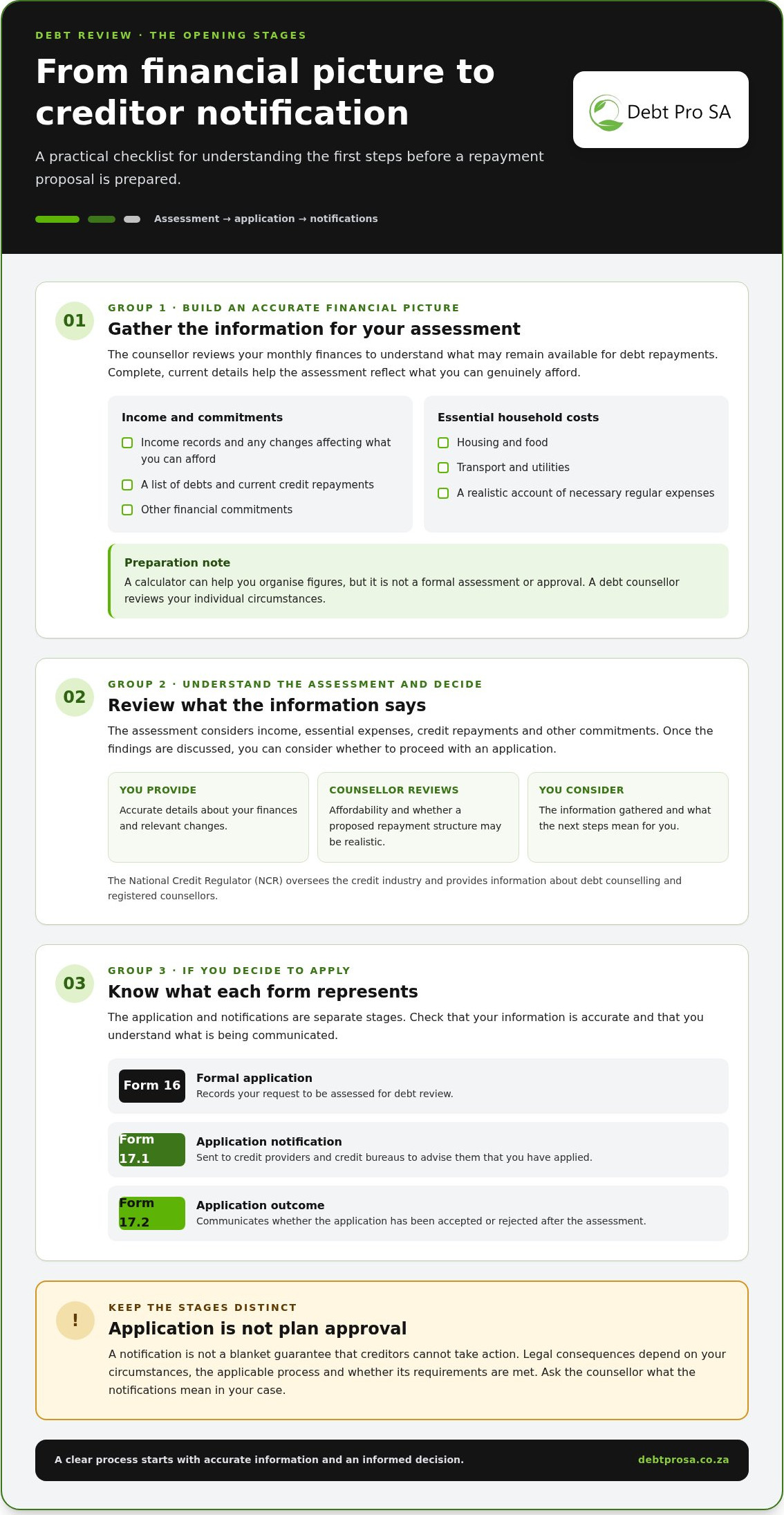
The opening steps establish whether debt review may suit your circumstances before a repayment proposal is prepared. The process moves from a financial assessment to a decision about applying, completion of the formal application and notifications to relevant parties. Take time to understand what information is being used and what each step means.
What happens during the initial financial assessment?
The counsellor builds a picture of your monthly finances by looking at income, essential household expenses, current credit repayments and other commitments. Your budget should account for regular costs such as housing, food, transport and utilities, as well as the amounts due on credit accounts. The aim is to understand what remains available for debt repayments, not to judge how you have managed your money.
Accurate details matter. Gather income records, a list of debts and a realistic account of necessary expenses. Missing or outdated information can make the assessment less representative of what you can genuinely afford. Debt Pro SA’s online calculator can help you organise these figures as a starting point, but it is not a formal assessment or approval. A debt counsellor reviews your individual circumstances.
Once the assessment is discussed, you can consider whether to proceed with an application. A registered debt counsellor can explain the information gathered and the next steps. The National Credit Regulator (NCR) oversees the credit industry and provides information about debt counselling and registered counsellors.
When does the formal debt review application begin?
If you decide to apply, the formal application is made using Form 16. This records your request to be assessed for debt review. The counsellor then sends the relevant notification, including Form 17.1, to credit providers and credit bureaus to advise them that you have applied. After the assessment, Form 17.2 communicates whether the application has been accepted or rejected.
These forms mark different points in the process. Applying is not the same as having a repayment plan approved, and a notification is not a blanket guarantee that creditors cannot take action. Legal consequences depend on your circumstances, the applicable process and whether its requirements are met. Do not assume protection applies to every account or situation. Ask the counsellor to explain what the notifications mean in your case.
Before signing, check that the information is accurate and that you understand the application and notification stages. If you’re still organising your figures, Debt Pro SA’s online debt calculator can help you prepare for a clearer assessment.
How creditors, repayment proposals, and formal approval fit together
After the affordability assessment, the counsellor uses your financial information to develop a proposed repayment structure. This is a working proposal, not an approved plan. It gives relevant credit providers a basis for considering how the accounts could be repaid within your assessed means. The debt review process step by step therefore includes distinct stages: preparing the proposal, receiving responses and, where applicable, formalising the arrangement.
How is a proposed repayment plan developed?
The proposal should take account of your income, essential living costs, existing debts and realistic capacity to repay. The aim is to create a sustainable structure across the relevant credit commitments, rather than set an instalment that looks manageable on paper but leaves too little for necessary expenses.
The counsellor engages with credit providers about the proposed terms. Their responses can affect what happens next. A proposal should not be treated as accepted simply because it has been prepared or sent. Changes to instalments or interest terms depend on the applicable agreement and process. Do not assume in advance that interest will be reduced or that a particular monthly payment will apply.
What does formal approval mean for the plan?
Once creditor responses have been considered, the matter may need to be formalised through an applicable legal route, which can include a Magistrates’ Court or the National Consumer Tribunal. Formal approval is different from an initial assessment or informal estimate: it records the arrangement through the relevant process. The route and outcome depend on the case, so not every application follows an identical path or timetable.
| Stage | Who acts | What you should understand |
|---|---|---|
| Proposal prepared | The debt counsellor | The suggested structure is based on the assessment, but it is not yet formal approval. |
| Proposal considered | Credit providers respond through the process | Responses may affect the proposed terms; sending a proposal does not mean every term has been accepted. |
| Formalisation, where applicable | The matter proceeds through the relevant court or Tribunal route | Formal approval is distinct from a counsellor’s estimate. The applicable process and outcome depend on the case. |
Before treating any figures as your payment arrangement, check which stage has been reached and what terms have been accepted or formalised. Ask the counsellor to explain any changes between the original proposal and the arrangement that proceeds, including how they affect your expected repayments. This helps you distinguish a suggested plan from a final one.
Debt review repayments: what to do and what to watch
Once the repayment arrangement is in place, staying organised helps you follow it and spot problems early. Before making payments, check that you understand the agreed amount, due date and payment route. Depending on the arrangement, payments may be collected and distributed to relevant credit providers through a payment distribution service. Follow the instructions you’ve been given, and clarify anything that’s unclear before a payment is due.
How can you keep repayments manageable?
Build the agreed payment into your monthly budget and keep a record each time you pay. Save confirmations and important messages, then compare your records with statements or account updates so you can query any unexpected difference. A simple folder or digital log makes it easier to confirm when a payment was made and follow up on a discrepancy.
Your circumstances can change during repayment. If your income falls or essential expenses rise, tell your debt counsellor promptly and explain what has changed. Do not quietly adjust the arrangement or assume a new amount will apply automatically. The counsellor can explain the appropriate next steps for your situation.
What if a payment becomes difficult to make?
If you’re worried you may miss a payment, contact the counsellor as soon as possible rather than waiting until the problem grows. Explain how much you expect to be short, when the difficulty began and whether it may continue. This gives the counsellor useful information to discuss your position and explain what options, if any, may be available.
A missed or at-risk payment does not, by itself, tell you exactly what will happen next. Do not assume the process is automatically cancelled, but do not assume legal protections remain unchanged or that creditor contact or action will stop. The consequences and available steps depend on the facts, the relevant creditors and the current legal position. Ask for guidance specific to your case, and keep a record of the discussion.
- Check: the payment amount, due date and required payment route.
- Keep: payment confirmations, account statements and relevant communications.
- Act early: raise changes in affordability or payment difficulties with your counsellor promptly.
Consistent records and early communication can help you understand where you stand as you follow the debt review process step by step. If you’re preparing for repayments, organise your debt review assessment with Debt Pro SA.
Starting debt review with Debt Pro SA: a clear next step
You don’t have to decide everything at once. The debt review process step by step begins with organising your finances, understanding your affordability assessment, reviewing any proposed repayment plan and deciding whether to proceed. An assessment helps clarify your position; it does not guarantee acceptance or a particular repayment outcome.
What should you understand before deciding?
Before agreeing to a plan, make sure you understand the proposed repayment amount, how and when payments are to be made, and your responsibilities during the process. Ask how the arrangement relates to your credit commitments and what to do if your income or essential expenses change. Also check which stage the matter has reached, since an assessment or proposal is not necessarily the same as formal approval.
Outcomes and timeframes depend on your financial circumstances and the applicable process. Take the time you need to consider the information. If you need guidance on eligibility or documents to prepare, raise these questions during your assessment.
How Debt Pro SA can help you take the first step
Debt Pro SA connects South African consumers with registered debt counsellors for personalised financial assessments. To prepare, gather a clear picture of your income, regular household costs and credit commitments. This gives the counsellor useful information to assess your affordability and explain the next steps in light of your situation.
Debt Pro SA’s online debt calculator can help you organise your figures before that conversation. Treat it as a starting tool, not an approval, final recommendation or substitute for an individual assessment. A counsellor-led assessment can help you understand whether debt review may be suitable and what a proposed arrangement could involve, without promising a particular result.
There’s no need to rush a decision. If you’re ready to explore the process with a clearer view of your finances, explore your debt review options with Debt Pro SA.
Take your next step with a clearer picture
Understanding the debt review process step by step can replace some uncertainty with a clearer path: organise your finances, have your affordability assessed, understand any proposed repayment plan and then decide how to proceed. An assessment does not promise acceptance or a particular outcome. The right next step depends on your circumstances.
Debt Pro SA connects consumers with registered debt counsellors for personalised financial assessments. Its online debt calculator can help you organise your income, expenses and credit commitments before discussing your position. If debt review is suitable, restructuring brings credit commitments into a repayment plan. It is not a new personal loan or debt write-off. Take time to understand the proposed amount, your responsibilities and what happens next.
Ready to explore your options? Take the first step with Debt Pro SA’s online debt calculator to organise your finances before discussing your position with a debt counsellor.
Frequently Asked Questions
What are the steps in the South African debt review process?
The debt review process step by step usually starts with a registered debt counsellor assessing your income, essential expenses and credit commitments. If you decide to apply, you complete Form 16 and the relevant notifications are sent. The counsellor then assesses whether you’re over-indebted and, where appropriate, develops a repayment proposal for consideration by credit providers. Any required formalisation follows the applicable route. The outcome depends on your circumstances and the process.
How long does the debt review process take?
There is no single timeframe for every debt review. The initial assessment and application stages are different from the longer period of making repayments under an accepted and formalised plan. Timing can depend on your finances, the number and type of credit accounts, creditor responses and the applicable formal process. Ask the debt counsellor to explain what stage your case has reached and what may affect its progress. Be cautious of anyone promising a fixed completion date.
What is Form 16 in the debt review process?
Form 16 is the prescribed application form used to apply for debt review in South Africa. It records your application; it is not itself a repayment proposal, creditor approval or court order. Provide accurate information and make sure you understand what you’re signing. After the application, the debt counsellor follows the relevant notification and assessment steps. Forms used at later stages serve different purposes, so ask the counsellor to explain each one as it applies to your case.
Can creditors still contact me during debt review?
Creditors may still contact you about accounts, payments or information, so keep records and do not ignore communications. The National Credit Act sets rules around debt review and enforcement, but the effect of an application depends on factors such as the account, the timing and whether the process is correctly followed. Do not assume every contact or legal step is automatically barred. If a creditor contacts you or threatens action, share the details promptly with your debt counsellor for guidance specific to your circumstances.
What happens if I cannot afford a repayment under debt review?
Tell your debt counsellor as soon as you realise a payment may be unaffordable, and explain what has changed, such as a drop in income or higher essential costs. Do not simply stop paying or assume the arrangement will change automatically. The appropriate next steps depend on your case, creditor responses and current legal position. Keep payment records and communications, and ask the counsellor to explain the possible consequences and options. A missed payment does not, by itself, establish what happens next.
Do I have to go to court during debt review?
Not necessarily. A repayment arrangement may need to be formalised through a Magistrates’ Court or the National Consumer Tribunal, depending on the case and applicable process. Formalisation does not always mean you’ll personally need to attend a hearing. The route, documents and any attendance requirements can vary, so ask the debt counsellor what applies in your situation. An assessment or proposed repayment plan should not be confused with a formal order.
Can I apply for credit while I am under debt review?
Generally, you cannot take out further credit while under debt review, subject to the rules and any applicable exceptions in South African credit law. Debt review is intended to help manage existing credit commitments, not provide access to new borrowing. Before making a credit application or accepting an offer, speak with your debt counsellor about your status and the consequences. Do not assume that an offer of credit means you’re permitted to enter a new agreement.
Recent Comments