

When monthly instalments compete with essentials, another loan or a promise to erase your debt may not be the answer. It’s understandable to want relief and still feel unsure about the legal process, credit impact or possible effect on your assets. This guide to debt review South Africa explains what the process is designed to do, without presenting it as a quick fix or debt cancellation.
You’ll learn how a registered debt counsellor assesses your finances and considers whether restructured repayments could be realistic for you. We’ll also cover the main stages, potential effects and limitations, including why your circumstances matter before you apply. By the end, you’ll have a clearer basis for weighing your options and discussing possible next steps with a registered debt counsellor.
Key Takeaways
- Debt review South Africa is a formal, counsellor-led process to assess your finances and consider structured repayments, not a new loan or debt write-off.
- Your income, essential expenses and debts help shape an assessment of whether a revised repayment plan could be realistic.
- Debt review may affect your credit profile, but it doesn’t erase your debts or guarantee a particular outcome.
- Before applying, consider whether a structured payment could fit your budget and whether you can maintain the agreed repayments.
- A debt calculator can help you review your financial position, while a registered debt counsellor can assess your circumstances and discuss possible next steps.
What is South African debt review and who is it for?
Struggling with repayments isn’t a reason for judgement. It’s a financial situation to understand and assess, so you can consider your options with clearer information.
Debt review in South Africa is a formal process under the National Credit Act 34 of 2005 in which a registered debt counsellor assesses a consumer’s finances and, where appropriate, helps arrange a structured repayment plan with creditors. The aim is to make repayments more manageable in light of the consumer’s circumstances. It restructures debt; it isn’t a new loan, debt cancellation or an informal payment holiday.
What does debt review mean under South African credit law?
The National Credit Act sets the framework for credit agreements and debt counselling. The National Credit Regulator (NCR) oversees the credit industry and registers debt counsellors. During debt review, the counsellor considers your income, expenses and debts, then assesses whether a revised repayment arrangement may be appropriate. The counsellor guides the assessment and process; the service is not legal representation.
A proposed arrangement doesn’t remove your responsibility to repay. If you proceed, understand the agreed payments and other requirements, and keep to them. Debt review isn’t permission to stop paying or a guaranteed reduction in what you owe. The details depend on your financial assessment and the arrangement reached.
What financial situation might lead someone to explore debt review?
You might consider an assessment if debt instalments leave too little for essentials, you’re falling behind on payments, or you’re using credit to cover groceries, transport or other regular household costs. These signs don’t determine whether debt review is right for you. They’re reasons to look at your whole financial picture before the pressure grows.
For example, if you’re paying several monthly instalments but still relying on a credit card for everyday expenses, your current commitments may not fit your budget. A counsellor-led assessment can clarify what you owe, what you can afford after essential expenses, and whether restructuring is realistic. A calculator can help you review your finances, but it can’t determine your suitability or replace a personal assessment.
There’s no single sign that settles the question. Your income, essential costs, debts and ability to maintain a revised payment all matter. Use the checklist below to reflect on these factors before considering your next step in debt review South Africa.
How debt review works: assessment, repayment restructuring, and oversight
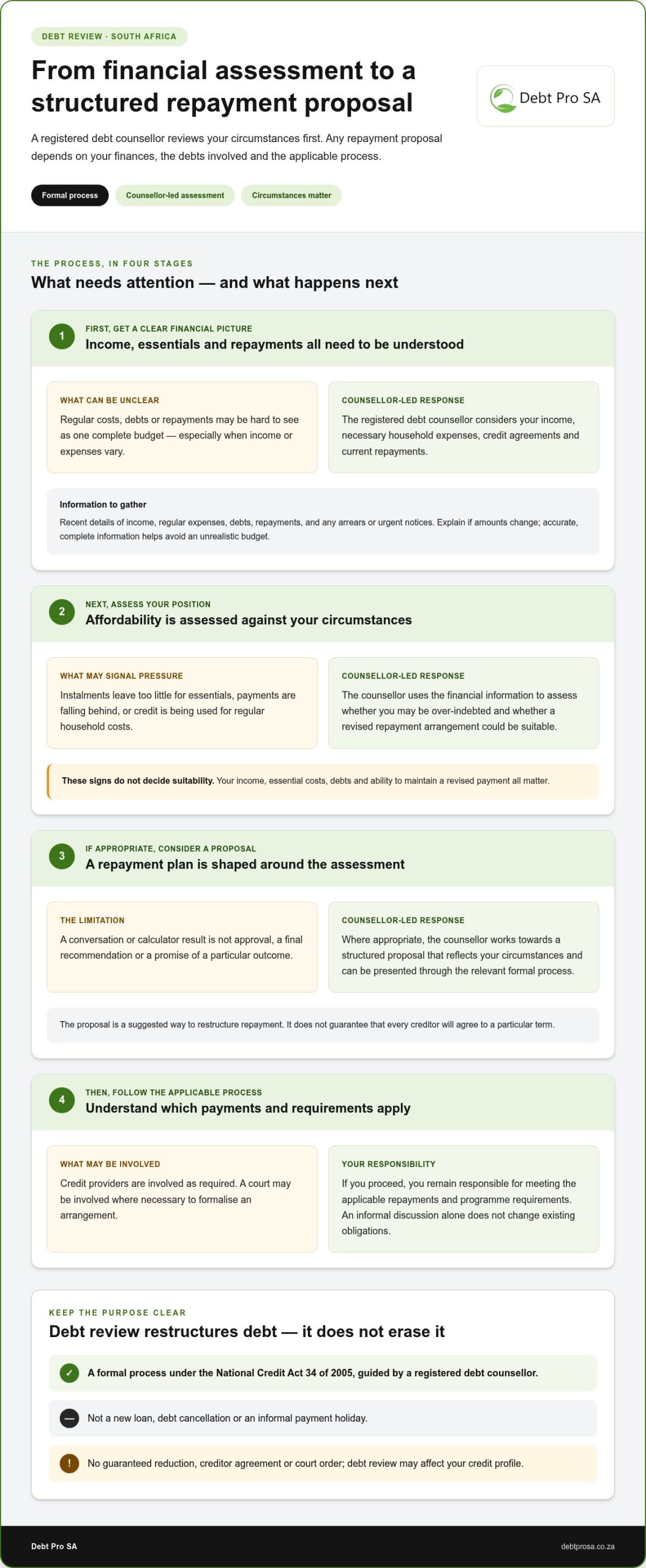
Debt review South Africa follows a structured process, but the details depend on your finances and the debts involved. The counsellor’s assessment is the starting point, not a promise that a particular repayment plan will be accepted or that you’ll qualify for a specific outcome.
- Review your finances. A registered debt counsellor considers your income, essential household costs, credit agreements and current repayments to understand what you can realistically afford.
- Assess your position. The counsellor uses this information to assess whether you may be over-indebted and whether a revised repayment arrangement could be suitable.
- Consider a repayment proposal. If appropriate, the counsellor works towards a structured proposal that reflects your circumstances and can be presented through the relevant formal process.
- Follow the process and payments. Credit providers are involved as required, and a court may be involved where necessary to formalise an arrangement. If you proceed, you remain responsible for meeting the applicable repayment and programme requirements.
What information is considered during the assessment?
The assessment needs a practical picture of money coming in and going out. This typically means looking at your income, necessary household expenses, credit agreements and existing repayment commitments. Accurate, complete information helps the counsellor understand what remains after essentials and avoid basing a proposal on an unrealistic budget.
To prepare, gather the documents and recent information about your income, regular expenses, debts, repayments and any arrears or urgent notices. If your income or expenses vary, explain that too, so the assessment can take your circumstances into account. You don’t need to guess at figures; identify what you know and where amounts change.
What happens after a repayment proposal is prepared?
The debt counsellor coordinates the assessment and proposal, while creditors and formal procedures play their part where applicable. The steps required depend on your circumstances and the arrangement being considered. An informal discussion alone doesn’t change your existing obligations. Follow the instructions provided as the process progresses, and make sure you understand which payments and other requirements apply.
A proposal is not debt cancellation. It is a suggested way to restructure repayment, and the process doesn’t guarantee that every creditor will agree to a particular term or that a court order will be made. Ask the counsellor to explain the proposed steps and how they apply to your situation.
Debt Pro SA connects consumers with registered debt counsellors for a personal financial assessment. You can also use the Debt Pro SA debt calculator to review your financial position as an initial step. The calculator isn’t approval or a final recommendation.
What debt review can change, and what it cannot promise
Debt review can create a structured way to address repayments, but it doesn’t change every part of your financial position. In debt review South Africa, the proposed arrangement depends on your circumstances, the debts involved and the applicable legal process. Treat any specific saving or outcome as something to assess, not assume.
| What may be possible | What isn’t guaranteed |
|---|---|
| Restructured instalments that better reflect assessed affordability | A lower payment or a particular monthly saving |
| Changes to repayment terms or interest, where agreed through the process | Debt cancellation, a write-off or forgiveness of outstanding balances |
| A coordinated repayment arrangement for debts included in the process | Automatic protection of every account, home or vehicle in every situation |
| A debt review status on your credit profile while the process applies | Immediate access to new credit or instant removal of the status |
How could debt review affect repayments, credit access, and assets?
A counsellor may propose revised instalments or terms to make repayment more manageable, but neither the proposal nor its outcome is guaranteed. Your debts remain obligations; restructuring changes how repayment may be organised, not whether the underlying debt exists.
Debt review is also relevant to your credit profile. A review status may be recorded with credit bureaus, and the National Credit Act generally restricts taking on further credit while you’re under debt review, subject to limited legal exceptions. This is different from having your debt erased. Your home or vehicle isn’t automatically protected in every circumstance either. The position can depend on the account, the stage of the process and whether payments are maintained.
Which common debt review claims need careful checking?
Be cautious if a claim makes a complicated process sound certain or immediate. Debt review isn’t a personal loan, a payment holiday or a shortcut that cancels balances. It involves assessment and formal steps, and you remain responsible for meeting the requirements of an arrangement that applies to you.
Promises of guaranteed approval, fixed savings or complete asset protection deserve careful scrutiny. A repayment proposal must be grounded in your actual income, essential expenses and debts. The outcome depends on your circumstances and the applicable legal process. A registered debt counsellor can explain what a proposed arrangement means for you, including its limits, before you decide how to proceed.
How to decide whether debt review fits your circumstances
There’s no need to decide under pressure. Use these questions to organise your thoughts and prepare for an individual assessment. They can help you consider whether a structured repayment arrangement might be worth exploring, but they don’t determine eligibility.
What should you understand before starting debt review?
Start with your monthly budget. After paying for essentials such as housing, food, transport and utilities, is there enough left to meet your current debt repayments? If you’re falling behind or borrowing to cover basic costs, reviewing your full financial position with a registered debt counsellor can help you understand the options.
Before that conversation, make a straightforward record of:
- your income and any changes or irregularities in it;
- essential household expenses and commitments to dependants;
- each debt, its current repayment and any arrears or urgent notices.
Use accurate figures where possible. A complete picture makes it easier to consider a repayment plan that reflects both your debts and the expenses you need to meet. Debt review South Africa should be considered in light of your own circumstances, not a general checklist alone.
What questions help you assess a proposed plan?
If a counsellor presents a proposal, take time to understand how it fits your budget and what it requires from you. Consider asking:
- How was the proposed monthly payment calculated after essential expenses?
- Which debts and repayment obligations does the arrangement cover?
- What fees apply, when are they payable, and how are they explained?
- What payments and other responsibilities must I keep up with?
- How will I receive updates, and what formal steps remain?
A manageable-looking payment still needs to be sustainable over time. Consider whether it leaves room for essential costs and how you would cope if your income or household expenses changed. Understand the arrangement before agreeing to proceed, including what could happen if you miss payments.
Debt Pro SA’s online debt calculator can help you review your financial position as an initial planning aid. It doesn’t replace counselling or decide whether a proposal is suitable. For a personal assessment and a clearer view of possible repayment options, explore your debt counselling options.
Taking a calm first step with Debt Pro SA
You don’t have to settle on a repayment arrangement before you understand your options. A personal financial assessment can help you build a clearer picture of your income, expenses, debts and repayment capacity. Debt Pro SA connects South African consumers with registered debt counsellors who review these details and discuss possible next steps based on the individual assessment.
What can you expect from an initial financial assessment?
The counsellor will consider what comes into your household, what you need to spend on essential costs, and what you currently owe and repay. Sharing accurate information helps build a realistic view of your finances. The discussion can then explore whether a structured repayment approach may suit your circumstances and what it could involve.
An assessment isn’t approval, a promise of a particular monthly payment or a guarantee of a specific result. Debt review South Africa is a formal process, and any possible arrangement depends on your financial position and the applicable steps. Take time to understand what is being proposed, which debts it addresses and which responsibilities would continue if you proceed.
The programme is intended to restructure repayments, not provide a personal loan or cancel your debt. Debt Pro SA’s debt calculator can help you review your financial circumstances before speaking with a counsellor, but its results are an initial planning aid, not a decision about eligibility or a final recommendation.
How can you prepare for a supported next step?
A little preparation can make the discussion more useful. Gather a clear picture of:
- your income, including any changes or variation;
- regular household expenses and essential commitments;
- your credit agreements, repayments and any arrears.
It may also help to write down questions about how a suggested payment has been worked out, what fees apply, how updates will be shared, and what you’ll need to do to keep to the arrangement. Make sure you understand the terms and implications before deciding whether to continue. If something is unclear, ask for it to be explained in plain language.
If you feel ready to explore your circumstances, start a personal debt assessment with support from a registered debt counsellor. There’s no need to rush the decision. A clear assessment can help you consider your options one step at a time.
Take your next step with clarity
Debt review South Africa is a formal way to consider restructuring repayments, not a new loan or a promise to erase debt. Whether it fits depends on your income, essential expenses, debts and ability to maintain an agreed payment. Understanding those limits can help you weigh possible support against the responsibilities involved.
You don’t need to decide before you have a clearer picture of your finances. Debt Pro SA connects consumers with registered debt counsellors for a personal assessment. Its online debt calculator can also help you review your financial position as an initial planning tool, though it can’t determine approval or recommend a final plan.
When you feel ready, explore your financial position with Debt Pro SA and take time to understand your options. Start with the debt calculator or arrange a personal assessment with a registered debt counsellor.
Frequently Asked Questions
What is debt review in South Africa?
Debt review in South Africa is a formal process under the National Credit Act 34 of 2005, in which a registered debt counsellor assesses your finances and may help arrange restructured repayments with credit providers. The assessment considers your income, essential expenses and debts. It’s intended to help over-indebted consumers manage repayments through a structured process, not to erase debt or provide an instant solution.
Is debt review a loan or does it write off debt?
No. Debt review isn’t a loan, and it doesn’t automatically write off or cancel what you owe. It is a debt counselling and restructuring process that may lead to a revised repayment arrangement, depending on your circumstances and the applicable process. You remain responsible for the debts covered and for meeting the requirements of any arrangement that applies to you.
Can I get credit while under debt review?
Generally, you can’t take on further credit while under debt review. The process is designed to help you manage existing credit commitments, rather than add new borrowing. Credit access may also be affected by your debt review status on your credit profile. If you’re unsure how the rules apply to a particular agreement or stage, ask your registered debt counsellor to explain your position before making a decision.
How long does debt review take in South Africa?
There isn’t one set timeframe for everyone. The duration depends on your debts, the repayment arrangement and how long it takes to meet the obligations covered by the process. Debt review may continue until the relevant debts are paid and the required steps to conclude it are completed. A registered debt counsellor can explain the likely process for your circumstances, but should not promise a guaranteed finish date.
What happens to my car or home under debt review?
Your car or home isn’t automatically taken because you enter debt review, but debt review can’t guarantee that every asset will be protected in every situation. The position depends on the credit agreement, the stage of any action and whether required repayments are maintained. Discuss secured debts, such as vehicle finance or a home loan, with your registered debt counsellor so you understand how they may be treated.
Will debt review stop creditors from contacting me?
Credit providers are notified as part of the debt review process, but that doesn’t mean every call or message will necessarily stop immediately. Contact may relate to account administration, payments or information about your arrangement. Keep records of communications and share concerns with your debt counsellor, who can help you understand what relates to the process. Debt review isn’t a blanket promise that creditors will never contact you.
Can I leave debt review whenever I want?
Leaving isn’t usually as simple as stopping payments or asking for the process to end. The appropriate route depends on your circumstances and the stage reached. Generally, debt review concludes when the relevant debts are settled and the required clearance process is completed. If you’re no longer over-indebted, a court application may be needed to rescind a debt review order. Speak with your debt counsellor before changing payments or taking action.
Recent Comments